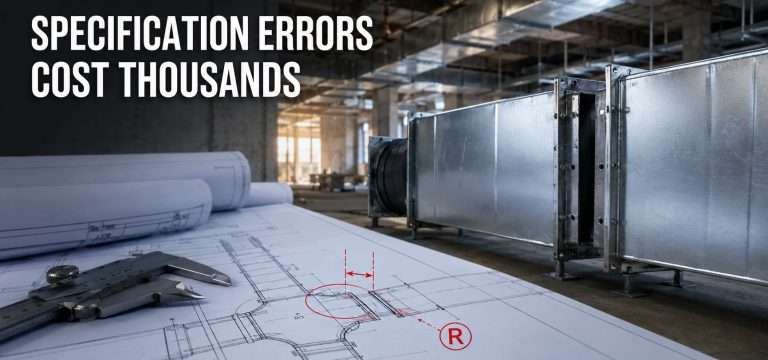
In South African construction, sound attenuators are often specified to solve one obvious problem: noise. They reduce the roar of generators, HVAC systems, plant rooms, extraction fans and other mechanical services that can affect occupants, neighbours and operational comfort. But there is another requirement that cannot be treated as an afterthought: fire safety.
For architects, contractors, mechanical engineers and project managers, the key point is simple. An attenuator is not just an acoustic product. Once it is installed in a duct, wall, plant room, service shaft or generator enclosure, it becomes part of a building system. That means it must be considered in relation to both noise control and fire compliance.
Compliance with SANS 10400 is deemed to satisfy the requirements of South Africa’s National Building Regulations (NBR), issued under the National Building Regulations and Building Standards Act (Act No. 103 of 1977). SANS 10400-T deals specifically with fire protection, including principles such as fire resistance, compartmentation, escape routes and fire safety systems. SANS 10400-O (Lighting and Ventilation) is also relevant where mechanical ventilation and airflow form part of the building design. SANS 10400-W, which covers fire installation requirements including suppression systems, may also apply depending on the building type and risk classification. Fire testing of building materials, components and elements is addressed through the SANS 10177 series.
Why fire compliance matters in attenuator installations
Sound attenuators are commonly used in air paths. This may include fresh air intakes, discharge ducts, smoke extraction routes, generator ventilation systems, basement plant rooms, risers and mechanical service zones. These are precisely the areas where fire safety details matter.
If an attenuator is incorrectly specified or installed, it can create several risks:
- It may compromise a fire-rated wall or compartment.
- It may allow smoke or flame spread through ductwork.
- It may obstruct required airflow for ventilation, smoke control or equipment cooling.
- It may introduce combustible materials into a high-risk area.
- It may fail inspection if documentation or test evidence is not available.
In other words, the right attenuator must do more than reduce decibels. It must support the overall fire strategy of the building.
The dual compliance challengeThe challenge for project teams is that acoustic and fire requirements can sometimes pull in different directions. Acoustic performance often depends on internal baffles, absorptive media and carefully designed airflow paths. Fire performance, however, depends on material behaviour, compartment integrity, correct sealing and the protection of penetrations.
This is where early coordination becomes essential. Waiting until the installation phase to ask whether an attenuator complies with the fire design can lead to delays, redesigns and costly site modifications. The better approach is to involve acoustic and mechanical specialists during design development, particularly where attenuators pass through rated walls, serve generator rooms or form part of smoke-related ventilation strategies.
Key areas to get right
1. Material selection
Not all acoustic materials are suitable for every building environment. The casing, internal baffles, acoustic media, facings, seals and fixings should be appropriate for the fire risk and project specification. Where required, materials should be selected with reference to relevant fire test information, including SANS 10177 requirements.
2. Fire-rated penetrations
Where ductwork or attenuators pass through a fire-rated wall, slab or compartment line, the opening must be treated correctly. The weak point is often not the attenuator itself, but the gap around it. Fire-stopping, sleeves, dampers and sealing details must be coordinated with the fire engineer’s requirements.
3. Dampers and access
In many projects, fire dampers or smoke dampers may be required in the duct system. The attenuator design must allow for correct placement, maintenance access and inspection. A beautifully quiet system is of little value if it prevents access to critical fire safety components.
4. Airflow and pressure drop
Fire safety and ventilation performance depend on reliable airflow. An attenuator that creates excessive pressure drop can affect fan performance, smoke extraction, generator cooling or fresh air delivery. Modern attenuators should be engineered to achieve the required acoustic reduction without unnecessarily restricting airflow.
5. Documentation
Compliance is not only about what is installed; it is also about what can be proven. Project teams should keep product drawings, material specifications, fire-related test information where applicable, installation details and sign-off records. This helps during inspections, handover and future maintenance.
Practical checklist for contractors and project managers
Before approving or installing an attenuator, ask:
- Does the attenuator form part of a fire-rated wall, duct, shaft or plant room?
- Has the fire engineer reviewed the proposed location and detail?
- Are the materials suitable for the building’s fire strategy?
- Are fire dampers, smoke dampers or access panels required nearby?
- Has pressure drop been checked against fan and ventilation requirements?
- Are installation drawings clear on sealing, supports and penetrations?
- Is the required compliance documentation available for handover?
Attenu-tec’s role in safer, quieter buildings
At Attenu-tec, we understand that acoustic performance cannot be designed in isolation. South African buildings need solutions that are quiet, efficient, durable and aligned with the broader compliance requirements of the project.
By working with architects, engineers, contractors and project managers from the early design stage, Attenu-tec helps ensure that sound attenuation supports the full building strategy — not just the noise target. From generator ventilation and HVAC systems to plant rooms and bespoke acoustic assemblies, our focus is on practical, locally manufactured solutions that perform on site.
Fire safety and noise control should never be competing priorities. With the right design approach, they can work together to create buildings that are safer, quieter and better built for South African conditions.