Facilities managers in South Africa face a relentless combination of dust, coastal humidity, and the harsh Highveld sun – conditions that are tough on your HVAC systems and attenuators. Facilities managers are a critical link between high efficiency and costly failure. A well-maintained attenuator should last 15-20 years, but in our environment, neglect can halve that attenuator’s lifespan.
In the face of operational pressures, the following five-step strategy will keep your attenuators—and your HVAC system—operating at peak efficiency and protect a significant capital asset.
The High Cost of Complacency
A simple, systematic check takes less than two hours per unit annually. Conversely, the failure of a single, critical sound attenuator can trigger a chain reaction:
- The system fails.
- Noise complaints spike.
- You face an unplanned capital expenditure for a full replacement, which often costs far more than 5-7 years of preventative maintenance.
Let’s dive into the simple, low-tech checks you can implement immediately.
Your 5-Step Attenuator Health Check
Adhere to a semi-annual, season-based schedule (pre-winter and post-winter) for the best results.
- Seasonal Plan
- Pre-summer: Focus on cleaning and flow rates before the heavy AC season.
- Post-Winter:** Inspect for moisture and seal integrity after the wet and cold season.
Step 1: The Six-Minute Visual Inspection (Quarterly)
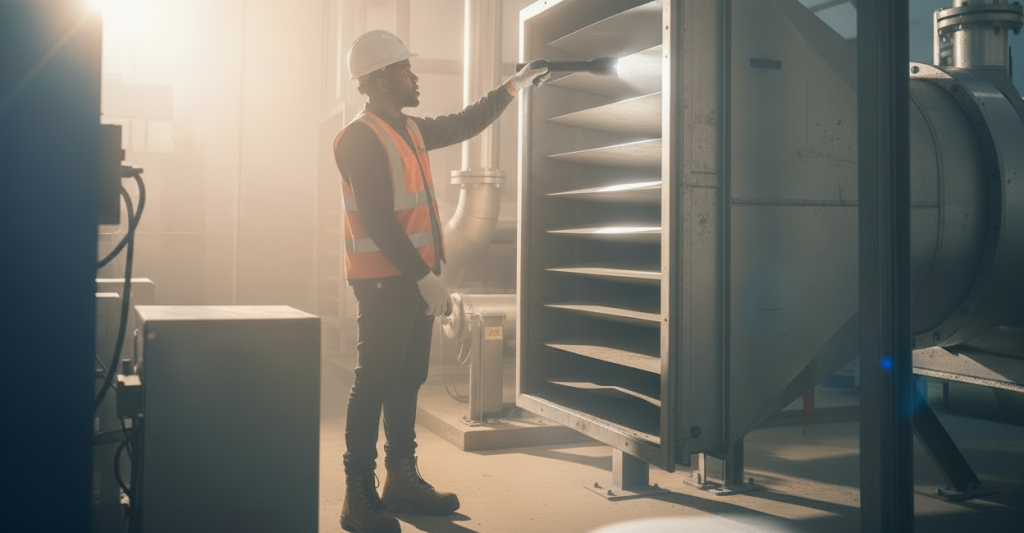
Before calling a specialist, do this yourself with a torch.
- Conduct a walk-around and use a torch to look for the ‘Dust of Doom’: Dark lines or shadows that signal dirty blades, or large debris that has bypassed the filters. Also, shine the torch at the blades—rust (red dust or flaking) is a major red flag for steel cassettes.
- South African Check: On the exterior, check inlet and exhaust louvres for dust clogs and any bird, vermin, or windborne litter blocking the free flow of air.
Step 2: The Clean Airflow Checklist (Biannually)
Clean airflow means efficient operation.
- With the system off, inspect your external filters (first line of defence for your attenuator). Clean or replace them per manufacturer’s schedule. A manometer reading at the attenuator will show a drop in pressure if the internal cassettes are clogged.
- Run a damp cloth along the intake louvres. A thick layer of grit means your filters may be failing.
Step 3: The Hum and Rattle Test (Quarterly)
Unusual sounds indicate immediate action is needed.
- Power the system to low during this test. Listen.
- Hum or Whine at Inlet? This is likely a dirty fan or a duct damper that’s out of position.
- Whistles or rattles from the acoustic panels of the attenuator suggest a loose panel or a compromised acoustic infill. Inspect panel fixings and rivets for signs of wear.
This five-minute check prevents a small rattle from becoming a cascade of detached panels.
Step 4: The Water Seal Check (Pre-Season)
Water destroys acoustic and thermal material.
- Using a high-quality, flexible sealant (butyl rubber-based products are often best for our temperature swings), run a clean, flexible probe (or a thin, blunt plastic tool) along all rubber seals you can reach. They must be flexible, not cracked or brittle. If in doubt, apply a silicone-based rubber conditioner.
Step 5: The Data You Must Track
If you record nothing else, track this data each season:
- External Static Pressure (ESP): Log baseline ESP and measure monthly. A 15% increase from baseline = time to inspect & clean.
- Noise Log: Note any dB increase from baseline.
- The Naked Eye Test: A bi-annual photo log of the same two internal baffles can be a simple yet powerful comparison tool.
The Power of a Service Partner
The most crucial check is also the simplest: know when to call a professional. An expert from a company like Attenu-tec can use a simple thermal camera to spot internal clogs, and conduct an air-leak test to ensure your unit is performing to factory specification.
Proactive Care Plan
For facilities managers looking to guarantee performance, we recommend:
- A full, annual inspection and service programme for your units. We handle the details, you sign off on the results.
- A twice-yearly inspection that goes far beyond the checklist above, using borescopes for internal inspections and ultrasound to check for seal integrity.
Don’t wait for the noisy failure. A single Attenu-tec inspection can save your facility from thousands in emergency call-outs and capital expense.