In the South African construction landscape, “sustainability” has graduated from a buzzword to a baseline requirement. With the Green Building Council of South Africa (GBCSA) leading the charge, developers and architects are increasingly aiming for Green Star certification – not just for the plaque on the wall, but for the tangible operational savings and increased asset value.
When we think of “Green Building,” our minds usually drift toward solar panels, greywater systems, and thermal glazing. However, a truly sustainable building is one that cares for its occupants. This is where acoustics plays a pivotal, often underestimated, role. A building that is energy-efficient but acoustically uninhabitable is not sustainable – it is a failure.
At Attenu-tec, we understand that noise control is a critical component of the eco-building ecosystem. Here is how modern sound attenuation supports your journey toward Green Star SA certification and meets the demands of the environmentally conscious market.
1. Green Star Indoor Environment Quality: The Silent Credit
The Green Star SA rating tool places significant weight on Indoor Environment Quality (IEQ). The logic is sound: if a building makes its occupants sick, stressed, or unproductive, it cannot be considered “green.”
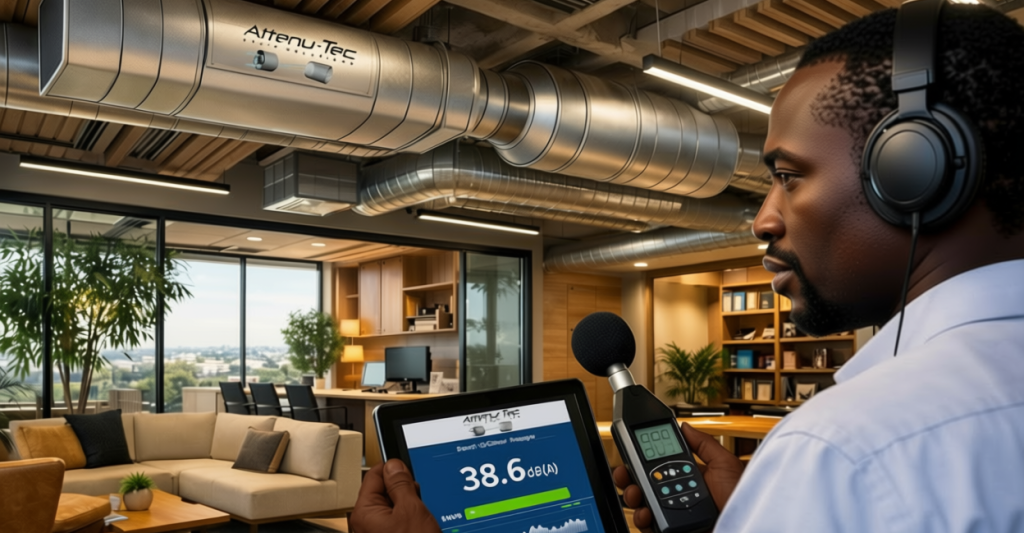
Noise pollution is a leading cause of workplace stress and reduced productivity. SANS 10400 standards provide the baseline, but Green Star pushes for higher performance. Our sound attenuators are engineered to reduce HVAC and mechanical noise to levels that promote well-being. By effectively silencing air handling units and exhaust systems, we support compliance with Acoustic Comfort requirements within the IEQ category. We ensure that the fresh air required for a healthy building doesn’t come with an exhausting soundtrack.
2. Green Star Energy Efficiency: The Aerodynamic Link
This is where physics meets finance. A common conflict in green design is the battle between ventilation and energy consumption. To earn energy credits, you need to lower your HVAC’s power usage. However, traditional, boxy sound attenuators create high “static pressure loss” – essentially acting as a brake on the airflow. This forces fans to spin faster and consume more electricity to push air through the system.
Attenu-tec’s modern attenuators are designed with aerodynamics in mind. Our specific blade profiles maximise noise reduction while minimising pressure drop.
- The Eco-Benefit: Lower pressure drop means fans run more efficiently.
- The Result: Reduced energy consumption for the building’s lifespan, contributing directly to the Energy category points in your Green Star rating.
3. Durability is Sustainability
In the circular economy, longevity is key. A product that needs replacing every five years creates waste and manufacturing overheads that negate its green credentials. South Africa has a harsh climate – from the humidity of Durban to the dry dust of the Highveld.
Cheap, imported attenuators often succumb to corrosion or “infill migration” (where the acoustic material breaks down and blows into the ducts). Attenu-tec manufactures robust units designed for the South African context. By installing long-life, corrosion-resistant attenuators, you reduce the building’s maintenance churn and material waste footprint, aligning with the Materials category of sustainable building.
4. Green Star Local Sourcing and Carbon Footprint
Sustainability is also about geography. Importing heavy steel equipment from Europe or Asia carries a massive carbon footprint due to shipping.
We are a proudly South African manufacturer. Sourcing your acoustic solutions locally does three things:
1. Reduces Transport Emissions: Drastically cuts the carbon cost of getting the product to the site.
2. Supports Local Economy: Contributes to local employment and skills development – a factor increasingly recognised in the broader definition of sustainable development in SA.
3. Green Star Points: The rating tool rewards projects that source a percentage of their materials locally.
5. Managing the “Green” Noise: Generators
Ironically, South Africa’s energy crisis has forced “green” buildings to rely on diesel generators during power cuts. There is nothing sustainable about noise pollution bleeding into the surrounding neighbourhood. A noisy building damages the local ecosystem and community relations.
Attenu-tec provides high-performance discharge and intake attenuators for generator rooms. This allows buildings to maintain power resilience without becoming a noise nuisance, ensuring the development remains a “good neighbour” – a core tenet of responsible urban planning.
The Sound of Sustainability
In a market where tenants are increasingly discerning, acoustic comfort is no longer a ‘nice to have’ – it’s a competitive differentiator. As architects and project managers, you are building the future of South Africa. That future needs to be energy-efficient, durable, and healthy for its inhabitants.
Don’t let noise be the invisible pollutant that compromises your Green Star rating. By integrating high-efficiency sound attenuators, you aren’t just silencing a fan; you are optimising energy use, supporting local industry, and creating spaces where people – and the planet – can thrive.