When it comes to acoustic control in HVAC systems, sound attenuators play a crucial role in reducing noise carried through ductwork. But how do we know whether an attenuator is doing its job effectively? The answer lies in a key performance indicator known as insertion loss.
This article unpacks what insertion loss means, how it’s measured, and why it’s essential in assessing the real-world performance of a sound attenuator.
What is Insertion Loss?
Insertion loss (IL) refers to the reduction in sound level achieved by inserting an attenuator into an air duct or ventilation system. It is expressed in decibels (dB) and measured across a range of frequencies, typically from 63 Hz to 8,000 Hz.
In simpler terms, insertion loss tells you how much quieter a system becomes when the attenuator is installed. For example, an attenuator with an insertion loss of 25 dB at 500 Hz will reduce the sound at that frequency by 25 decibels—a significant improvement in perceived quietness.
Why Insertion Loss Matters
Insertion loss is a direct reflection of an attenuator’s ability to reduce unwanted noise. It allows engineers, contractors, and specifiers to:
- Compare performance between different attenuator models or suppliers.
- Select the right attenuator for specific applications (e.g., hospitals vs. warehouses).
- Meet building acoustic requirements or compliance standards.
- Ensure occupant comfort in sensitive areas such as offices, schools, or residential buildings.
Simply put, a high-quality attenuator with properly rated insertion loss can make the difference between a disruptive HVAC system and a silent, seamless one.
How Is Insertion Loss Measured?
Insertion loss is measured in a controlled acoustic test environment, usually in accordance with recognised international standards such as ISO 7235: Acoustics — Laboratory measurement procedures for ducted silencers.
In South Africa, SANS (South African National Standards) often mirror or adopt ISO standards. SANS 10103 is the standard for environmental noise rating.
The process involves three basic steps:
- Baseline Measurement
Sound is introduced into a duct without the attenuator installed. Microphones placed downstream record the sound pressure level at various octave bands. - With Attenuator Installed
The attenuator is then installed in the same duct setup. The same sound signal is introduced, and the downstream sound levels are measured again.
Calculate the Difference
The insertion loss is calculated by subtracting the second set of readings (with attenuator) from the first (without attenuator), frequency by frequency.
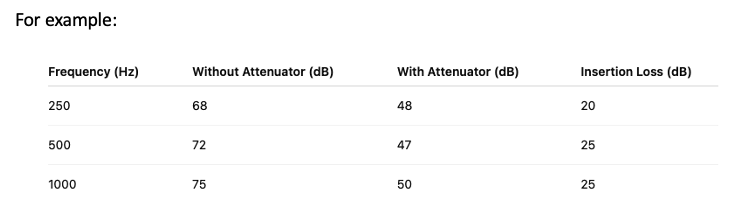
Interpreting Insertion Loss Data
Insertion loss is not a single figure—it varies across the frequency spectrum. That’s because attenuators behave differently at different frequencies:
- Low-frequency noise (63–250 Hz) – rumble or mechanical drone – is harder to suppress and often requires specially designed baffles or deeper attenuators.
- Mid-to-high frequencies (500 Hz and above) are generally easier to attenuate and where most attenuators show peak performance.
Therefore, when reviewing an attenuator’s specification sheet, it’s important to look at the full frequency breakdown—not just the average.
Real-World Considerations
While laboratory insertion loss figures are valuable, real-world conditions can affect performance:
- Installation quality: Poor duct sealing or gaps around the attenuator can reduce effectiveness.
- Airflow conditions: High air velocities can create regenerated noise and impact attenuation.
- Duct layout: Bends, transitions, and distance from the noise source can influence acoustic results.
South African Challenges:
- Skill Level of Installers: Ensuring proper installation to achieve stated insertion loss values can sometimes be a challenge due to varying skill levels in the local construction industry.
- Cost vs. Performance Trade-offs: In some South African projects, budget constraints can heavily influence material selection, requiring a balance between ideal acoustic performance and project cost.
- Extreme Climates: South Africa’s diverse climates (hot, cold, humid, dry) can influence HVAC system design and, by extension, the choice and performance expectations of attenuators.
This is why working with a knowledgeable manufacturer – like Attenu-tec – is essential. We ensure our products are not only tested to international standards but also suitable for real-world HVAC conditions found across South African commercial, industrial, and residential projects.
Final Thoughts
Insertion loss is the gold standard for evaluating the performance of sound attenuators. It gives engineers and building designers the confidence that the product selected will meet acoustic requirements, maintain airflow, and contribute to occupant wellbeing.
At Attenu-tec, we’re proud to provide tested, proven attenuators that offer outstanding insertion loss without compromising on pressure drop or airflow efficiency. If you’re designing a quiet, comfortable space, we’re here to help you make it happen.